
Turquoise History and Lore

Turquoise is one of the world’s most ancient gems. Archaeological excavations revealed that the rulers of ancient Egypt adorned themselves with turquoise jewelry, and Chinese artisans were carving it more than 3,000 years ago. Turquoise is the national gem of Tibet, and has long been considered a stone that guarantees health, good fortune, and protection from evil.
The gem’s name comes from the French expression pierre tourques, or “Turkish stone.” The name, which originated in the thirteenth century, reflects the fact that the material probably first arrived in Europe from Turkish sources.
Turquoise is a rare gemstone that forms in dry, arid regions when copper-rich groundwater moves through rocks containing aluminum and phosphorus. Through this natural process, it becomes a porous mineral made of hydrated copper and aluminum phosphate, ranging from semi-translucent to opaque in appearance.
Its color can range from light blue to greenish blue or yellow-green, depending on the minerals present during formation. Higher copper content often produces blue tones, while iron or zinc can create greener shades. Some stones also contain a visible “matrix,” or veining from the surrounding rock, which can add character and value.
Turquoise has a long history in jewelry and ornamentation, including use in ancient Egypt and strong associations with Persian culture. It is also an important and sacred material in Southwestern Native American art, especially among Pueblo, Hopi, Zuni, and Navajo artists.
Because turquoise ranks about 5 to 6 on the Mohs hardness scale, it is soft enough to carve and shape, making it especially suitable for jewelry. Highly prized varieties include Spiderweb Turquoise, known for its fine web-like matrix, and Sleeping Beauty Turquoise, valued for its smooth, even blue color.
Typically, turquoise is judged on three basic quality factors—color, texture, and the presence or absence of matrix.
Turquoise Color

The green turquoise cabochon, from an American mine, might become part of a designer’s unique jewelry piece. The even blue color of the cabochon on the right would be called “Persian blue” in the trade.
Blue Turquoise The most-prized turquoise color is an even, intense, medium blue, sometimes referred to as robin’s egg blue or sky blue in the trade. The traditional source for this color is the Nishapur district of Iran, so you’ll also hear it described as “Persian blue,” whether or not it was actually mined in Iran (formerly known as Persia).
Green Turquoise Generally speaking, turquoise with a green to greenish blue color is less desirable than turquoise with a pure blue hue, but it depends on personal preference. There are some contemporary designers who actively seek avocado and lime green turquoise.
Popular Types of Turquoise by Mine/Variety (in alphabetical order)
Bisbee (Blue):


Bisbee turquoise is prized for its deep blue color and distinctive chocolate-brown to smoky black matrix. Mined from Arizona’s Lavender Pit Mine in Bisbee, it was discovered during copper mining and became known worldwide for its beauty, hardness, and rarity. Since the mine closed in 1974, Bisbee turquoise has become even more collectible and highly sought after by jewelry makers and turquoise enthusiasts.
Carico Lake:


Carico Lake turquoise comes from a dried lakebed in Lander County, Nevada. It is known for bright blue and vivid green stones, with the green color linked to high zinc content. The rare lime-green material is especially collectible and is sometimes associated with Faustite. The mine is also known for turquoise-filled pseudomorph clam fossils, formed when ancient clam-shaped cavities filled with turquoise over time.
Dry Creek:


Dry Creek turquoise comes from a small mine near Austin, Nevada. Discovered in the early 1990s, it was later confirmed as turquoise through lab testing. Its rare pale blue color comes from low levels of both copper and aluminum. Unlike most pale turquoise, Dry Creek is naturally hard, polishes well, and usually needs no stabilization, making it highly collectible.
Kingman:
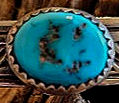

Kingman turquoise is a well-known Arizona turquoise, prized for its bright blue color, dark matrix, and distinctive veining. Mined in northwestern Arizona, the Kingman Mine has a long history, with commercial mining beginning in the 1880s. Known for producing many shades of blue, including the industry-standard “Kingman blue,” it remains one of the most sought-after turquoise varieties.
Morenci:

Morenci turquoise is a famous Arizona turquoise known for its bright true-blue color, dark matrix, and distinctive pyrite inclusions that can appear silver when polished. Originally found in the Morenci copper mine, it became popular in Native American and Southwestern jewelry. Since the mine is now depleted, high-quality Morenci turquoise is rare, collectible, and highly sought after.

Royston turquoise comes from a historic mine near Tonopah, Nevada, active since the early 1900s. It is prized for its vibrant mix of greens and blues, often appearing together in one stone, with a distinctive golden-brown to dark matrix. Its bold colors and natural veining make it popular in handcrafted Native American sterling silver jewelry.
Sleeping Beauty Turquoise:

Sleeping Beauty turquoise is prized for its pure sky-blue to robin’s-egg blue color and little to no matrix. Mined in Globe, Arizona, it became one of the world’s most recognizable and collectible turquoise varieties. Its clean, vibrant color makes it especially popular in fine Southwestern and Native American jewelry.

Sonoran turquoise comes from the Sonoran Desert region and is often found as nuggets in clay deposits rather than veins. Sonoran Gold is especially admired for its vibrant aqua blue, lime, and bright green tones, often mixed with golden-brown matrix. Its fresh colors and unique formation make it a popular and collectible turquoise variety.
Treatment Techniques used with Turquoise
Natural/Untreated:
Natural stones, polished without chemical additives, representing less than 3% of the market, making natural stones more valuable than treated stones
Stabilization:
Soft, porous turquoise treated with colorless epoxy resin to increase durability, bringing it to a harder consistency, however this lowers the value of the turquoise.
Treated/Dyed:
Soft, chalk-like stones such as Howlite treated with dye and resin to enhance color and strength. This unfortunately has been done to “fool” consumers into thinking that what they are purchasing is genuine turquoise when in fact, it is a much less valuable stone.
Reconstituted:
Turquoise powder or dust mixed with epoxy and coloring agents, molded into synthetic nuggets. This technique can be used to make “block turquoise” which is NOT genuine turquoise, but has unfortunately been marketed as such.
Turquoise Chip:

Turquoise chip jewelry is made with small pieces of turquoise that are carefully arranged to create colorful, textured designs. This style is closely connected to Southwestern Native American jewelry traditions, where artists have long used silverwork, stone setting, and inlay techniques to create detailed wearable art.
In this technique, tiny turquoise fragments or crushed stones are placed into sterling silver channels or settings, forming mosaic-like patterns. Inlay jewelry often requires each stone to be cut, shaped, and fitted into the artist’s design, creating a finished piece that reflects both precision and creativity. One of the appealing qualities of turquoise chip jewelry is its resourcefulness. Smaller turquoise pieces, including fragments left from cutting larger cabochons, can be transformed into new jewelry rather than discarded. The result is a distinctive style that celebrates the natural variation of turquoise while showcasing the skill and imagination of the maker.


Comments