
Jocla Earstring Necklaces: Origins, Materials and Meaning

Updated: Sep 11
A Jocla earstring necklace looks simple at first: strands of small beads, often with turquoise drops, tied or hung in pairs. Look closer, and it becomes a record of trade routes, Pueblo beadmaking skill, ceremonial dress, and changing Native jewelry traditions across the Southwest.
Often spelled jacla, and sometimes described as “earstrings,” the Jocla belongs to a family of adornments connected to Pueblo communities, especially Kewa, formerly known as Santo Domingo, and to the wider jewelry traditions of the Diné, Zuni, Hopi, and other Southwestern peoples. It is more than decoration. Its materials, colors, and form carry meaning.
The Beauty of Jocla Necklaces: A Journey Through Time and Culture
Jocla earstring necklaces are more than just beautiful pieces of jewelry; they are a testament to the rich cultural heritage of the Southwest. Each necklace tells a story, weaving together history, artistry, and tradition.
Jocla Earstring Necklaces: A Connection to Pueblo Beadwork and Southwest Exchange
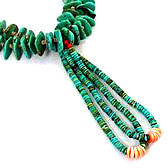
The word Jocla is commonly used for a pair of beaded ear pendants, usually made with strands of heishi and finished with turquoise or shell elements. In many museum, jewelry, and collector contexts, the spelling jacla appears more often, but both terms point to the same general object: paired earstrings that could be worn from the ears or attached to a necklace.
Their roots sit in the long beadmaking traditions of the Pueblo peoples of the Southwest. Kewa Pueblo is especially known for heishi, the small, carefully shaped beads made from shell, stone, or other materials. These beads were produced long before modern jewelry markets existed. The work required patience, skill, and a strong understanding of hard natural materials.
Before metal tools became widespread, beadmakers shaped shell and stone with stone implements, abrasives, drilling methods, and hand finishing. Later, metal tools made parts of the process faster, but the eye and hand of the maker remained the heart of the craft.
Jocla earstrings also reflect the geography of the region. The Southwest did not exist in isolation. Shell traveled inland from coastal areas. Turquoise moved between mining regions and communities. Coral arrived through Spanish and later global trade. Over time, these materials became part of local artistic languages.
That history helps explain why a small necklace can hold such a wide map of meaning. It may include ocean shell, desert turquoise, trade coral, and Pueblo heishi, all gathered into one wearable form.
The Materials Tell the Story of Place, Value, and Skill
Traditional Jocla necklaces and earstrings use materials that are beautiful, durable, and meaningful. Not every example contains the same mix, but several materials appear again and again.
Common materials include:
Turquoise
Turquoise is one of the most recognized stones in Southwestern jewelry. Its blue and green tones often connect with sky, water, protection, and life-giving forces. In Jocla earstrings, turquoise may appear as tabs, nuggets, tear-shaped drops, or small beads.
Shell
Shell is central to heishi. White shell beads, often made from clam, mother-of-pearl, or similar shell materials, bring a clean visual rhythm to the strands. Shell also shows the reach of older trade networks, since inland Pueblo communities relied on exchange to obtain ocean materials.
Coral
Red coral became prominent after contact with Spanish and Mediterranean trade systems. In Southwestern jewelry, its red color often adds balance against turquoise and white shell. It also came to signal wealth, taste, and connection to long-distance exchange.
Jet and other dark stones
Black materials such as jet, lignite, or dark stone create contrast. In some pieces, black, white, red, and blue-green elements work together in a balanced color structure.
Sinew, cotton cord, leather, or later thread
The stringing material matters because Jocla pieces depend on flexibility. The strands must hang correctly, move with the body, and hold small beads securely. Older examples may use natural fibers or sinew, while later pieces often use cotton, nylon, or other modern threads.
Silver
Silver is not always central to older Jocla forms, but it appears in later necklaces, especially when Jocla pendants became attached to Navajo-style necklaces or squash blossom necklaces. This reflects the rise of silverwork in the Southwest during the historic period.
The beauty of Jocla work lies in repetition with variation. A strand of heishi may look uniform from a distance, yet each bead was shaped and finished individually. The result is not mechanical perfection. It is rhythm.
The Practical Design of a Jocla Necklace
A Jocla earstring is not just a strand of beads. It has a clear structure. Even when individual makers vary the pattern, the basic components tend to follow a recognizable design.
Component | What it Does | Common Materials |
Ear loops or paired strings | Hang from the ears or attach to a necklace | cord, sinew, cotton, trade thread |
Heishi strands | Create the main beaded body | Shell, turquoise, jet, coral, stone |
Pendant drops | Add weight, movement, and visual focus | Turquoise, shell, coral, stone |
Connector area | Joins the strings to each other or to a necklace | cord wrapping, beads, later silver findings |
Color pattern | Gives rhythm and meaning | White shell, blue-green turquoise, red coral, black jet |
The “earstring” name comes from the way these pieces were worn. Rather than being small earrings in the modern sense, they often hung as longer beaded pendants. In some traditions and later jewelry forms, pairs of Jocla were tied to a necklace so they rested against the chest.
That shift is one reason modern viewers may know them as necklace elements rather than earrings. A pair might be attached near the lower portion of a bead necklace and still be removable, or they might not be removable. Examples of both are pictured below. These are both available at Tanner Tradition in Ruidoso, NM.
The design has both practical and visual logic. The drops add weight, helping the strands hang straight. The small beads create flexibility. The repeated colors draw the eye downward. When worn, the piece moves gently, so the body becomes part of the design.
Heishi: The Heart of Jocla's Craftsmanship
To understand Jocla, it helps to understand heishi. The word is often associated with Kewa Pueblo and refers to small disk-shaped or tube-shaped beads, traditionally made by hand from shell or stone. Heishi beads are drilled, strung, ground, shaped, smoothed, and polished until they form even strands.
The process is demanding. A maker must select material, cut or break it into workable pieces, drill holes, string the rough beads, and grind them together so the strand becomes smooth and regular. The beads are small, but the skill is large.
Heishi relates to Jocla in two main ways.
First, heishi provides the structure. Many Jocla earstrings depend on rows of tiny beads that hang in supple strands. Without heishi, the Jocla would lose much of its texture and movement.
Second, heishi connects Jocla to Pueblo identity and economy. Kewa beadmakers became especially respected for fine heishi production. Their work moved through trade and later through jewelry markets, helping shape what many people now recognize as Southwestern jewelry.
Heishi also differs from later mass-produced beads. Modern bead strands can be imported, machine-shaped, and highly uniform. Handmade heishi carries subtle differences. These small variations show the maker’s hand.
That matters because Jocla is not only about the finished ornament. It is also about the labor behind it. Each tiny bead represents cutting, drilling, grinding, polishing, sorting, and stringing. The necklace becomes a record of time.

Symbolic Meanings: Protection, Balance, Identity, and Exchange
No single meaning applies to every Jocla necklace. Meaning changes by community, family, maker, wearer, and occasion. Still, several broad symbolic themes appear often in Southwestern jewelry traditions.
Turquoise often represents protection and life. Its color evokes sky and water, both powerful forces in arid regions. Many Native Southwestern traditions value turquoise for more than appearance. It can mark blessing, well-being, and connection to place.
Shell can suggest water, distance, and exchange. Since shell came from ocean environments, it carried the memory of faraway places. Inland communities transformed it into local art, giving the material a new life.
Red coral adds color, prestige, and trade history. Its presence points to later exchange networks. It also creates a strong visual pairing with turquoise, a combination now closely associated with Southwestern jewelry.
Paired earstrings suggest balance. Jocla are usually understood as a pair. That pairing creates symmetry on the body and balance in design. When attached to a necklace, the two hanging forms often frame the central pendant or chest area.
Jocla necklaces may also represent social identity. They can show ties to Pueblo beadwork, family tradition, ceremonial dress, or regional style. In some settings, they mark respect for continuity. In others, they show connoisseurship, since collectors often value older handmade heishi and natural turquoise.
Still, it is best not to reduce Jocla to one fixed symbol. These pieces live in many contexts. A family heirloom carries a different weight than a tourist-market necklace. A ceremonial item carries a different meaning than a collector’s display piece. The form may look similar, but the relationship to it changes.
The Wearers of Jocla Necklaces: A Cultural Evolution

Historically, Jocla earstrings were most closely linked with Pueblo dress and adornment. They were worn as ear pendants and later appeared as necklace ornaments. Pueblo women are often associated with this form in historic descriptions, though jewelry use in the Southwest has never fit neatly into one simple rule.
As trade, intermarriage, collecting, and shared regional aesthetics grew, Jocla pieces moved across communities. Navajo wearers and silversmiths incorporated related pendant forms into necklaces. Collectors and traders also helped spread the term and the object into the wider market.
Today, Jocla necklaces may be worn by:
Pueblo people as part of cultural dress or personal adornment
Diné and other Southwestern Native people within regional jewelry traditions
Dancers, singers, and community members during appropriate events
Collectors of Native American jewelry
People who purchase contemporary Native-made pieces for wear or display

The key word is appropriate. Some Jocla pieces are ordinary adornment. Others may hold family, ceremonial, or community meaning. Provenance matters. So does buying from Native artists, Native-owned businesses, or reputable sources that respect the maker’s identity.
Jocla Necklaces and Their Role in Trade
Jocla earstrings themselves were not currency in the strict modern sense. They were not standardized like coins, and they did not carry a fixed value across every community.
Yet the materials used in Jocla absolutely played a role in trade. Shell beads, turquoise, coral, and finished beadwork could all function as valuable exchange goods. In many Indigenous economies, value was not limited to money. A beautiful strand of beads might represent labor, rarity, social connection, and access to distant exchange routes.
So the best answer is careful:
Jocla necklaces were valuable trade objects and could take part in exchange, but they were not a formal currency in the way coins or paper money are.
A strand of fine heishi required many hours of skilled work. Turquoise could be rare and highly desired. Shell had to travel long distances. Coral linked wearers to broad trade networks. These factors made Jocla materials portable stores of value.
In trade settings, one piece might be exchanged for goods, labor, or other jewelry. Its worth depended on material quality, craftsmanship, age, cultural context, and relationships between the people involved.
The Evolution of Jocla: From Ear Adornment to Collectible Art
The Jocla form changed as materials, markets, and wearing styles changed.
Early forms emphasized shell and stone beadwork. As new trade goods entered the Southwest, coral, glass beads, metal findings, and silver became more common. Later, as tourism and collecting grew, makers adapted designs for outside buyers while also continuing community traditions.
Several shifts shaped the modern Jocla:
From ear pendants to necklace ornaments
Pieces once worn as earstrings became attached to necklaces. This made them more visible to buyers familiar with chest-worn jewelry.
From all-handmade beads to mixed materials
Some contemporary pieces still use handmade heishi. Others combine handmade elements with commercial beads. Quality varies widely.
From local use to global collecting
Jocla necklaces now appear in galleries, auctions, museum collections, and online shops. This wider market brought attention, but also confusion over terms, origins, and authenticity.
From traditional patterns to contemporary design
Native artists continue to reinterpret the form. Some use classic shell and turquoise. Others experiment with color, scale, and arrangement while keeping ties to older beadwork principles.
The evolution of Jocla is not a story of loss alone. It is also a story of adaptation. Native jewelry traditions have always responded to new materials and markets. What matters is who controls the making, how the work is represented, and whether cultural knowledge receives respect.

Jocla Necklaces: A Tapestry of History in Every Bead
Jocla earstring necklaces bring together material beauty and cultural memory. Their shell beads point to ocean trade. Their turquoise reflects Southwestern stone traditions. Their coral records later global exchange. Their heishi shows patient Pueblo craftsmanship. Their paired form speaks through balance, movement, and presence on the body.
They may have circulated in trade, and their materials could hold real exchange value, but Jocla were never just money. They were adornment, skill, identity, and relationship made visible.
The most useful way to look at a Jocla necklace is to slow down. Notice the beadwork. Notice the pairing. Notice the materials and how far they traveled. A small strand can carry a long history if given the attention it deserves.


Comments