
Hopi Pottery

As with the other pueblos Hopi pottery is hand-coiled and traditionally fired outdoors. They gather their clay from traditional sites and pieces are polished by hand and painted after firing. Modern Hopi pottery design was significantly influenced by the excavation of Sikyátki in 1895. Sikyátki was a large Hopi village abandoned in the 1500s. During the excavation of this ancient village, an amazing number of centuries old beautifully painted pottery was unearthed. The Hopis respected these ancient designs and led by Nampeyo, one of the Hopi pueblo potters, they began making new pottery in Sikyátki polychrome style.

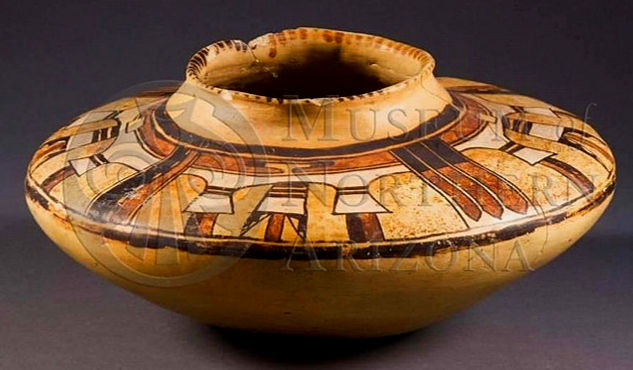
Hopi pottery is characterized by its earthy colors, such as red, brown, and cream. The designs are often inspired by nature, featuring animals, plants, and abstract symbols. Hopi pottery was strongly influenced by the rediscovery of prehistoric Hopi pottery at the Sikyátki archaeological site, an ancient Hopi village. Hopi potters often recreate these prehistoric Sikyátki -style designs in their contemporary work.
Nampeyo was born on First Mesa in the village of Hano, also known as Tewa Village which is primarily made up of descendants of the Tewa people from Northern New Mexico who fled west to Hopi lands about 1702 for protection from the Spanish after the Pueblo Revolt of 1680.
Hopi people make ceramics painted with beautiful designs, and Nampeyo was eventually considered one of the finest Hopi potters. In the 1870s, Nampeyo made a steady income by selling her work at a local trading post.

Hopi people make ceramics painted with beautiful designs, and Nampeyo was eventually considered one of the finest Hopi potters. In the 1870s, Nampeyo made a steady income by selling her work at a local trading post.
Nampeyo became increasingly interested in ancient pottery form and design, recognizing them as superior to Hopi pottery produced at the time. Nampeyo developed her own style based on the traditional designs, known as Hopi Revival pottery from old Hopi designs and Sikyátki pottery. This is why researchers refer to her style as Sikyátki Revival after the proto-historic site.

Nampeyo was particularly skilled. Her pottery became a success and was collected throughout the United States and in Europe.

“When I first began to paint, I used to go to the ancient village and pick up pieces of pottery and copy the designs. That is how I learned to paint. But now, I just close my eyes and see designs and I paint them.”— Nampeyo, 1920s
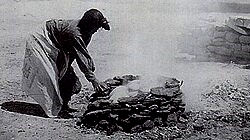
Nampeyo used sheep bones in the fire, which are believed to have made the fire hot or made the pottery whiter, and smoothed the fired pots with a plant with a red blossom. Both techniques are ancient Tewa pottery practices. Nampeyo used up to five different clays in one creation when the usual was two.
One of her famous patterns, the migration pattern, represented the migration of the Hopi people, with feather and bird-claw motifs. An example is a 1930s vase in the collection of the Smithsonian Institution's National Museum of the American Indian in Washington, D.C. Her work is distinguished by the shapes of the pottery and the designs. She made wide, low, rounded, shaped pottery and, in later years, tall jars. Many of her works are identifiable by her "recognizable designs" and "her artistic idiosyncrasies."

Examples of Hopi pottery and pottery from other tribes can be purchased at Tanner Tradition in Ruidoso, NM.


Comments