
Who are the Hopi People?
- Barbara Behrens

- Jun 5
- 5 min read
Their History
The Hopi tribe is in Northeastern Arizona on 2,500 square miles in the middle of the Navajo Nation. The Reservation is divided into 12 traditional villages built on and around three distinct plateaus, known as First, Second, and Third Mesas. Each mesa has its own distinct history, cultural heritage, and renowned styles of traditional Hopi artistry. There are currently less than 20,000 enrolled members of the Hopi tribe, a small number compared to the Navajo Nation surrounding them. The name “Hopi” is a shortened version of the longer name they call themselves, which means “The Peaceful Ones”. This concept of peacefulness and balance permeates Hopi life and culture. Finding peacefulness and reverence with all things is central to the Hopi way of life. Their religious ceremonies are performed and observed for the benefit of all mankind- to bring balance to Earth and its inhabitants.

The Hopis deliberately built their villages on the mesa tops and dry farmed in the ravines running down the mountain sides. The Spanish recorded the Hopi Village, Old Oraibi, as having 1,500 - 3,000 residents in 1540. Old Oraibi is still an active Hopi village and community and is considered the oldest continuously inhabited settlement in North America. To this day, residents of Old Oraibi choose to continue a traditional lifestyle and live without modern comforts such as electricity, plumbing, or running water although the population is much smaller now.
The precise origin of the Hopi is unknown, although it is thought that they and other Pueblo peoples descended from the Ancestral Pueblo (Anasazi), whom the Hopi call “Ancient People.” Archaeology has revealed that some abandoned pueblos were once occupied by Hopi people. Hopi origin traditions tell that their ancestors climbed upward through underground chambers called kivas and lived in many places before reaching their present settlements in this, the Fourth World. According to the Hopi legend of creation, we still live in the fourth world. The Hopi describe this world as a ruthless, materialistic and imperialistic world where man reflects the gross appetites of the flesh.
Hopi people believe that we have suffered three previous world cataclysms. The First World was destroyed by fire, a comet, asteroid strike, or several volcanic eruptions. The Second World was destroyed by ice, a great Ice Age. As recorded by many cultures around the globe, a tremendous deluge destroyed the Third World.
These three global destructions were not the result of merely random earth changes or astrophysical phenomena but of humankind’s disregard both for Mother Earth and for the spiritual dictates of the Creator. In other words, cataclysmic events in the natural world are causally connected to collective transgressions or negative human actions.

Traditional Hopi culture emphasized monogamy and matrilineal descent. Matrilineal descent is a kinship system in which lineage, social identity, inheritance, and succession are traced exclusively through the female line. In this system, children belong to their mother’s descent group, and family property or titles are typically passed from mothers to their daughters. Hopi people also practiced matrilocal residence, in which a new husband becomes part of his mother-in-law’s household. A given pueblo, or town, might include two dozen or more matrilineal clans; these were grouped into several larger social units, or phratries which are a structural unit in indigenous societies or a subdivision of a tribe.
The traditional Hopi economy centered on farming and, after Spanish colonization, on herding sheep. The chief crop was corn (maize), and the Hopi also grew beans, squash, melons, and a variety of other vegetables and fruits. Men farmed and herded, in addition to building houses, performing most of the ceremonies, making moccasins, and garments and blankets. Women made baskets and pottery, gardened, raised children, cared for the elderly, and were responsible for the strenuous tasks of providing their families with hand-drawn water and hand-ground cornmeal.

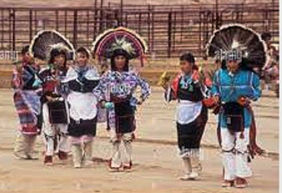
Girls and boys began their ceremonial careers soon after reaching six years of age by being inducted into the kachina (Hopi: katsina) religious tradition. Hopi kachinas represented a wide variety of gods, spirits, departed ancestors, and clouds; during certain ceremonies they were impersonated by men in elaborate regalia. Women generally took the role of observers during the public aspects of ceremonies, except in events involving one or more of the three women’s societies. Men also had the option of joining several societies, including those that conducted a strenuous tribal initiation and staged an annual winter solstice celebration, or soyal. The leadership of the winter solstice celebration is usually only entrusted to a high official, usually the town’s chief.
Girls and boys began their ceremonial careers soon after reaching six years of age by being inducted into the kachina (Hopi: katsina) religious tradition. Hopi kachinas represented a wide variety of gods, spirits, departed ancestors, and clouds; during certain ceremonies they were impersonated by men in elaborate regalia. Women generally took the role of observers during the public aspects of ceremonies, except in events involving one or more of the three women’s societies. Men also had the option of joining several societies, including those that conducted a strenuous tribal initiation and staged an annual winter solstice celebration, or soyal. The leadership of the winter solstice celebration is usually only entrusted to a high official, usually the town’s chief.

The most widely publicized Hopi rituals had been the Snake Dance, held annually in late August, during which the performers danced with live snakes in their mouths. Although part of the Snake Dance was performed in public, visitors saw only a brief, though exciting, portion of a lengthy ceremony, most of which was conducted privately in kivas. The Snake-antelope dance of the Hopi in Arizona involves a rite in which snakes are released in the four directions to seek rain. It also includes dancing to rattles and a guttural chant, circling the plaza area with snakes and ceremonial sprinkling of corn meal. Some say that the ceremony became extinct, but Hopi elders have commented that if it was lost, it was because they didn’t need it anymore and that if they really needed it back again, they could start it again.
The most widely publicized Hopi rituals had been the Snake Dance, held annually in late August, during which the performers danced with live snakes in their mouths. Although part of the Snake Dance was performed in public, visitors saw only a brief, though exciting, portion of a lengthy ceremony, most of which was conducted privately in kivas. The Snake-antelope dance of the Hopi in Arizona involves a rite in which snakes are released in the four directions to seek rain. It also includes dancing to rattles and a guttural chant, circling the plaza area with snakes and ceremonial sprinkling of corn meal. Some say that the ceremony became extinct, but Hopi elders have commented that if it was lost, it was because they didn’t need it anymore and that if they really needed it back again, they could start it again.
Some aspects of Hopi life were considerably affected because of the Spanish, and later American, colonization and then land disputes between the Hopi and the neighboring Navajo. However, many aspects of traditional Hopi life persisted into the early 21st century. At that time, terraced pueblo structures of stone and adobe continued to dominate the architecture of several independent Hopi towns. Kachina religion remained vibrant, and a strong craft tradition persisted in Hopi communities.


Comments