
White Sands National Monument A Stunning Landscape of Gypsum Dunes and Desert Adventure

White Sands looks like a snowfield dropped into the desert, but the bright waves underfoot are not ice. They are gypsum, a soft mineral that usually dissolves in water before it can gather into dunes. In southern New Mexico, rare geology, an enclosed basin, and steady desert winds created one of the most unusual dune fields on Earth.
Many travelers still know the place as White Sands National Monument, the name it carried for decades before becoming White Sands National Park in 2019. By either name, it protects a dazzling stretch of white dunes in the Tularosa Basin, surrounded by the San Andres and Sacramento Mountains. The result is a place that feels almost unreal: cool white sand, blue skies, rippled ridges, desert plants holding on by their roots, and sunsets that turn the whole basin pink, gold, and violet.
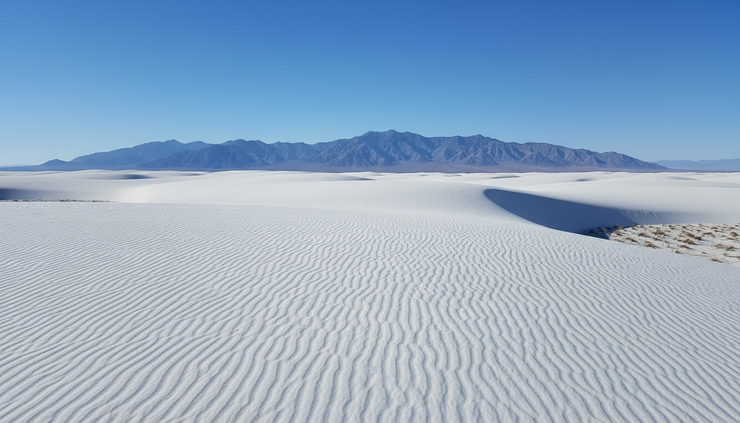
What White Sands is and why it is so unusual
White Sands protects the largest gypsum dune field in the world. The dunes stretch across a broad desert basin in southern New Mexico, where gypsum sand covers the ground in sweeping curves and high, wind-shaped ridges.
Most sand dunes are made of quartz. That is the typical tan, brown, or reddish sand found in many deserts and beaches. White Sands is different because its grains come from gypsum crystals, a mineral made of calcium sulfate. Gypsum is common in rocks, but gypsum sand is rare because gypsum dissolves easily in water.
That is the key to White Sands. The surrounding mountains contain gypsum-rich rock. Rain and snowmelt wash dissolved gypsum down into the basin. Since the Tularosa Basin has no river that drains to the sea, the water cannot carry the mineral away. Instead, it collects in low areas, evaporates under the desert sun, and leaves gypsum behind.
Over time, those mineral deposits break down into tiny grains. Wind lifts, pushes, and sorts them into dunes. The process is still happening, which makes White Sands a living landscape rather than a fixed one.
The dunes also have a practical surprise: they stay cooler than many darker sands because their pale color reflects sunlight. On hot days, the air can feel intense, but the sand itself often feels more comfortable underfoot than expected.
How the gypsum dunes were formed
The story of White Sands begins with ancient seas, rising mountains, and a basin that trapped water instead of releasing it.
Long before the dunes existed, shallow seas covered parts of what is now the American Southwest. Over time, layers of gypsum formed from those ancient waters. Later, mountain-building forces lifted and exposed gypsum-bearing rock in the nearby ranges. Weather slowly broke that rock down.
Rainfall and snowmelt in the mountains dissolved gypsum and carried it into the Tularosa Basin. Because the basin is closed, water pooled in temporary lakes and low flats rather than flowing out to an ocean. One of the most important of these low areas is Lake Lucero, a dry lakebed for much of the year.
When water evaporates there, it leaves behind selenite crystals, a clear form of gypsum. These crystals can grow into flat, glassy blades. Wind, temperature changes, and weathering break them apart. The fragments get smaller and rounder until they become the fine white sand that defines White Sands.
From there, wind does the sculpting.
The dunes move, shift, and rebuild as gusts push grains across the basin. Some dunes advance slowly across the desert floor. Others anchor around plants. The shapes change with the season and the weather, giving repeat visitors a different view each time.
Common dune forms at White Sands include:
Wave-like ridges
Long ripples that form under steady wind.
Crescent dunes
Curved dunes shaped by wind moving mostly in one direction.
Plant-anchored dunes
Mounds that gather around shrubs and grasses.
Open dune fields
Smooth, rolling areas where the sand appears to stretch without interruption.
This combination of mineral, basin, wind, and sun creates a place that cannot be copied. The dunes look delicate, but they come from a powerful and ongoing geological cycle.

Hiking through a bright desert world
White Sands is easy to enjoy from roadside pullouts, but walking into the dunes changes the experience. The silence deepens. The road disappears behind low ridges. Every dune crest reveals another curve of white sand and sky.
The park offers several marked trails, ranging from short boardwalk routes to longer backcountry hikes. The Interdune Boardwalk is a good starting point for learning about plants and wildlife without committing to a long walk. Dune Life Nature Trail explores the edge of the dunes, where animal tracks and hardy plants are easier to spot. The Alkali Flat Trail is the most demanding marked route, despite the name. It crosses open dunes and feels remote quickly.
Hiking here calls for more care than the scenery suggests. The land looks open and simple, but the sameness of the dunes can make direction confusing. Trail markers matter. So do water, sun protection, and timing.
A few smart hiking practices make the visit safer and more enjoyable:
Start early or later in the day during warm months.
Carry more water than seems necessary.
Wear sunglasses, since white sand reflects strong light.
Follow trail markers and turn back if visibility drops.
Avoid hiking far into the dunes during storms or high winds.
The reward is worth the preparation. Hiking at White Sands is not only about distance. It is about texture, light, quiet, and scale. A short walk can feel immersive when the dunes rise around you like frozen waves.
Photography is one of the great reasons to visit
White Sands is a dream location for photography because it turns simple elements into striking images. Sand, shadow, sky, mountains, and footprints are enough.
The best light often arrives near sunrise and sunset. At those hours, shadows stretch across the dunes and reveal patterns that disappear under harsh midday sun. The white sand reflects color from the sky, so the dunes can shift from silver to peach to lavender in a matter of minutes.
Midday can still work well for bold, minimalist photos. The contrast between white dunes and deep blue sky creates clean compositions. Wind ripples, yucca plants, and lone hikers can add scale without clutter.
Good photo subjects include:
Curving dune crests against the sky
Footprints crossing untouched sand
Desert plants rising from white gypsum
Mountain silhouettes at sunset
Animal tracks in the morning
Moonlit dunes during evening programs or full-moon visits
White Sands also rewards patience. A scene that looks flat at first can come alive when a cloud passes, the sun lowers, or wind sharpens the surface texture.

Sledding, scenic drives, and simple desert fun
White Sands is not only a place to admire from a distance. It is also one of the most playful protected landscapes in the United States.
Dune sledding is a favorite activity. Visitors use saucer-style sleds to slide down smooth dune slopes. The gypsum sand does not pack like snow, so the ride is different, but the fun is real. The best sledding spots are usually away from road edges, where slopes are steeper and smoother.
The Dunes Drive offers an easy way to see the area by car. This scenic road passes from desert scrub into the heart of the white dunes. Pullouts let visitors stop for photos, short walks, picnics, and sunset views. The drive is especially useful for families, first-time visitors, or anyone with limited time.
Picnicking at White Sands has its own charm. Some picnic shelters stand among the dunes, offering shade in a place where shade is precious. A simple meal can become memorable when the view looks like an endless white sea.
Other low-key ways to enjoy the park include:
Watching clouds cast shadows across the sand
Looking for animal tracks near plant-covered areas
Walking barefoot for a short stretch when sand temperatures are safe
Sitting quietly at sunset as the dunes change color
Visiting after weather changes, when the surface patterns shift
The landscape invites movement, but it also rewards stillness.
Stargazing under wide New Mexico skies
After sunset, White Sands becomes a different place. The bright glare fades. The dunes soften. The sky opens.
Southern New Mexico has broad horizons and dry desert air, which can make for excellent stargazing when conditions are clear. The white dunes also reflect moonlight, giving the basin a soft glow during bright lunar nights. On darker nights, stars can feel close and sharp, especially away from nearby lights.
Stargazing here works best with a little planning. Check operating hours before visiting, since access can vary, and some evening experiences depend on scheduled programs or special openings. If night access is available, bring layers because desert temperatures can drop quickly after dark.
A flashlight with a red-light setting helps protect night vision. It also makes walking safer without washing out the stars. On full-moon nights, the dunes can be bright enough to give the whole place an eerie, beautiful quality.
For many visitors, the night sky completes the White Sands experience. The same dunes that look blazing and bold at noon become quiet and lunar after dark.

Wildlife has adapted to a harsh and changing place
At first glance, White Sands may seem too bright and exposed for wildlife. Look closer, especially near dawn, dusk, and plant-covered dunes, and signs of life appear everywhere.
Many animals avoid the heat of the day. They come out at night or stay hidden in burrows. Their tracks often tell the story before the animals themselves appear. Visitors may see delicate lines from insects, tiny prints from rodents, or winding trails from reptiles.
Some animals in and around White Sands have adapted to the pale environment. Several species are lighter in color than their relatives outside the dunes, which helps them blend into the gypsum sand. This kind of adaptation makes White Sands important not only as a scenic destination, but also as a place to study evolution and survival.
Wildlife connected to the area includes:
Lizards that move quickly across hot open sand
Kangaroo rats and other small mammals that emerge at night
Kit foxes and coyotes that travel through the basin
Beetles, moths, and other insects adapted to dune life
Birds that use shrubs, grasslands, and open spaces for food and shelter
The best way to observe wildlife is to slow down. Tracks, burrows, scat, and movement near vegetation reveal a busy desert system. White Sands is not empty. It is subtle.
Plant life survives by anchoring the dunes
Plants face a tough challenge at White Sands. The dunes move, bury stems, expose roots, and create dry conditions. Yet plant life persists in clever ways.
Soaptree yucca is one of the most recognizable plants in the park. As sand piles around it, the plant can keep growing upward, sometimes forming tall stalks that seem to rise straight from the dunes. Skunkbush sumac can form pedestals when roots hold sand in place while the surrounding dune moves away. Grasses help stabilize parts of the dune field and provide shelter for small animals.
These plants do more than survive. They shape the dunes around them. A shrub or yucca can slow the wind just enough for sand to collect. Over time, the plant becomes an anchor point in a shifting world.
Plant life also adds contrast to the scenery. A green yucca blade or dark shrub against white sand creates one of the classic White Sands images. The plants remind visitors that this is not a blank landscape. It is a living desert shaped by struggle, adaptation, and time.
Why White Sands belongs on a must-visit list
White Sands stands out because it combines rare geology with easy access and a wide range of experiences. Some national park landscapes require long hikes to reach the most iconic views. At White Sands, the wonder begins close to the road, yet the dunes still offer solitude for those willing to walk farther.
It is a must-visit destination for several reasons:
The scenery is unlike anywhere else
The white gypsum dunes create a clean, luminous setting that feels both peaceful and dramatic.
The landscape changes constantly
Wind reshapes the dunes, light changes their color, and tracks appear and vanish.
Activities fit many travel styles
Hiking, sledding, photography, scenic driving, picnicking, and stargazing all work here.
The science is fascinating
The dunes tell a story of ancient seas, closed basins, evaporating lakes, and mineral sand.
The ecosystem is more alive than it first appears
Plants and animals have found ways to thrive in a bright, shifting desert.
White Sands is also memorable because it engages the senses. The sand feels fine and cool. The light can be almost blinding at midday. The wind brushes patterns across the surface. At sunset, the whole basin seems to breathe color.
For a first visit, plan enough time to see the dunes in changing light. Arrive before sunset if possible, walk a marked trail, take photos from several angles, and leave time simply to sit on a dune crest. If conditions allow, return for a night-sky experience or a full-moon visit.
White Sands is more than a beautiful stop in southern New Mexico. It is a rare meeting of geology, desert life, and recreation. The dunes invite curiosity, movement, and awe, and they leave a clear impression long after the gypsum sand has been shaken from your shoes.


Comments