
Exploring the Origins of Apache Ledger Art

The Apache Wars were a series of conflicts between the United States and the Apache from 1862 to 1886. Stemming from smaller Apache raids on a farm and a military wagon train in Arizona, the United States used this as an opportunity to force the Apache onto a reservation. This twenty-four-year conflict ended in the summer of 1886, with the final surrender of Geronimo, the famed Apache military leader. With the end of the conflict, around five hundred Apache men, women, and children became prisoners of war and were taken to Fort Marion (the Castillo de San Marcos).
In the late 1800s the Apache people were taken as prisoners and held in the Castillo de San Marcos, Florida (then called Fort Marion). They sold sketches done on old ledgers (used paper), which were the only things they had to draw on to St. Augustine residents and tourists who came to the fort. This ledger art represented Apache efforts to establish autonomy even while imprisoned in St. Augustine.

These were not the first indigenous prisoners of war held at Fort Marion. During the Second Seminole War, the U.S. imprisoned eighty-one Seminoles there in 1837. Around forty years later, they also held seventy-five captives from Great Plains nations, including Kiowa and Cheyenne prisoners. The prisoners during the 1870s created ledger art to be sold to St. Augustine’s tourists. Historically, people from the Plains recorded war histories and other events with drawings done on bank ledgers. With this background, the prisoners during the 1870s created ledger art to be sold to St. Augustine’s tourists. Almost a decade later, the Apache did the same.
Selling ledger art to White tourists provided the Apache funds to purchase foods that the government refused to provide. The typical daily rations included meat, sugar, coffee, bread, and beans. Notably absent from these provisions were fruits and vegetables— except for a small number of potatoes and onions on a weekly basis. Imprisonment limited Apache access to food. So that they could supplement their diets, several turned to selling handicrafts to the tourists who would come to view them in the fort. These objects included beadwork, bows, arrows, moccasins, and ledger art. While the Kiowa and other Plains nations created far more artwork during their time in St. Augustine, all these nations produced ledger art for a commercial purpose during their imprisonment.
The subjects of these drawings included scenes from Apache life out west. Most of that collection are hunting scenes, such as bison hunts, portraits of Native Americans, or horses. The choice to depict these scenes showcased the tourists’ interests in owning a piece of ‘Apache life,’ despite the fact the Apache created these depictions specifically to be souvenirs.

While being deprived of nutrition, freedom, and sovereignty, the Apache were able to exercise a limited amount of economic autonomy through the production of this ledger art. By selling this art, they were able to raise sufficient funds to purchase food and supplies that would not otherwise have been available to them. Their art not only provides a window into the perspectives and experiences of Apache prisoners of war, but it also demonstrated their ability to maintain that sense of self-expression at a time even though the U.S. was attempting to assimilate native cultures. The Apache people were able to maintain their identity against incredible odds.

Raul Davis, a current day Mescalero Apache, has shared that he searches the web to find old ledgers pages to do his artwork on as a way of attempting to put a more positive face on a negative time in his ancestor’s history. The images that he chooses to create are not based upon wars but are based upon daily life and culture of the Apache people. Typically, they are peaceful images. One of the interesting characteristics of the ledger pages he selects is their age. The ledger pages he selects may be as old as 100 years and the writing on them was done with fountain pens since ballpoint pens were not yet invented!
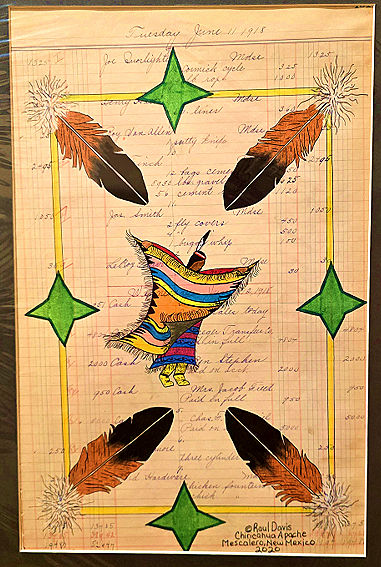
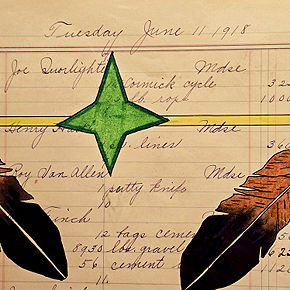

In this example, the paper was dated June 11,1918 and one of the items that was purchased was a buggy whip. The sale price of that buggy whip was $1.00. That information makes the art piece not only a historical document for the time, but a conversation piece as well.
Symbolically, Raul has incorporated the four-pointed star (or "Apache cross") into his artwork. To the Apache, this geometric symbol is sacred representing the Four Directions and the fundamental balance of the universe. The number four is deeply woven into Apache culture, and daily life. The four points of the star carry specific, interconnected meanings each with four as the central theme. These include:
The Four Cardinal Directions of North, South, East, and West. The Four Seasons of the year: Spring, Summer, Autumn, and Winter. The Four Sacred Mountains: Mountains of the Southwest which are those that surround traditional Apache homelands defining the boundaries of their territory. These include the Sierra Blanca, Guadalupe Mountains, Three Sisters Mountain and Oscura Mountain Peak. The Four Cycles of Life: Infancy, youth, adulthood, and old age. The Four Sacred Elements & Colors: White, Yellow, Black, and Blue. White represents the North, the season of winter, and life. Yellow represents the West, the season of fall, and the sun. Blue represents the South, the season of summer, and the sky. Black represents the East, the season of spring, and the creation of night.
The four-pointed star symbol is frequently used to represent harmony and the interconnectedness of all living beings. This shape is often used on ceremonial items, traditional basketry, and the headdresses of the Apache Crown Dancers (who channel the sacred Ga'an mountain spirits) to offer protection and blessings. In other words, it’s present in many aspects of daily life of the Apache people.
Raul has also drawn feathers, specifically Eagle feathers in the ledger art example provided. To the Apache people, feathers are sacred gifts from the Creator, symbolizing a deep spiritual connection, honor, and guidance. These feathers act as spiritual messengers, particularly carrying prayers to the heavens, and are awarded to individuals to recognize acts of bravery, leadership, or major life transitions. Eagle Feathers are considered the most sacred, symbolizing strength, courage, and divine connection. Eagles are believed to fly closest to the Creator. Because of this, they are used in ceremonies to carry prayers. Consistent with the use of “four” there are four eagle feathers and four, four-pointed stars in the example of Raul’s ledger art that was provided.
Other Apache artists also create ledger art and Tanner Tradition in Ruidoso, NM has a nice selection of framed and unframed pieces available in their Ruidoso, NM location.


Comments